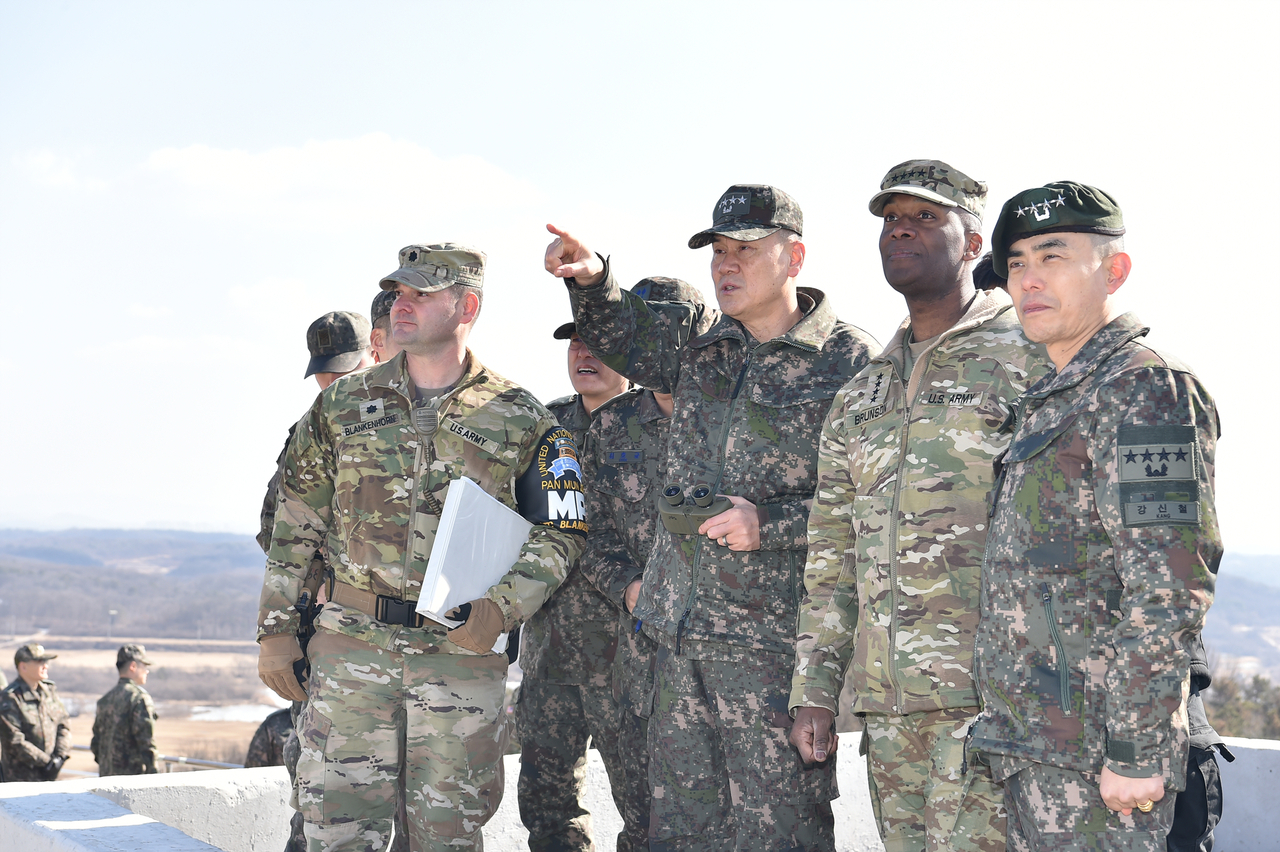
Top military officers overseeing allied forces on the Korean Peninsula for South Korea and the United States visited the Joint Security Area on Friday to assess the alliance’s readiness against North Korea’s provocations.
According to South Korea’s Joint Chiefs of Staff, Adm. Kim Myung-soo, chair of the Joint Chiefs of Staff, and Gen. Xavier Brunson, commander of the South Korea-US Combined Forces Command and head of US Forces Korea, visited the JSA and inspected key operational facilities near the Military Demarcation Line, the border between North and South Korea.
The JSA is the only section of the Korean Demilitarized Zone where North and South Korean forces stand face-to-face. It is located at Panmunjom in Paju, Gyeonggi Province, approximately 54 kilometers north of Seoul.
This joint visit to the JSA marked the first combined on-site inspection by South Korean and US military leadership since Brunson assumed office in December 2024.
During the visit, Adm. Kim emphasized the unwavering strength of the South Korea-US combined defense posture, calling for further strengthening of the alliance’s operational capabilities to ensure an immediate and decisive response to any provocation by North Korea.
Gen. Brunson underscored the importance of maintaining combined readiness as a key pillar of South Korea’s defense, stating, “We are committed to deterring any hostile acts and defending South Korea.”
Both Kim and Brunson stressed the importance of combined exercises between South Korean and US forces as essential to enhancing interoperability, readiness and deterrence.
Brunson doubles as the commander of the United Nations Command, the multinational military force established to support South Korea during and after the Korean War (1950-1953).
In peacetime, operational control of South Korean forces remains under the chair of the Joint Chiefs of Staff. In the event of war, operational control shifts to the commander of the Combined Forces Command, leading the South Korea-US allied forces.
flylikekite@heraldcorp.com