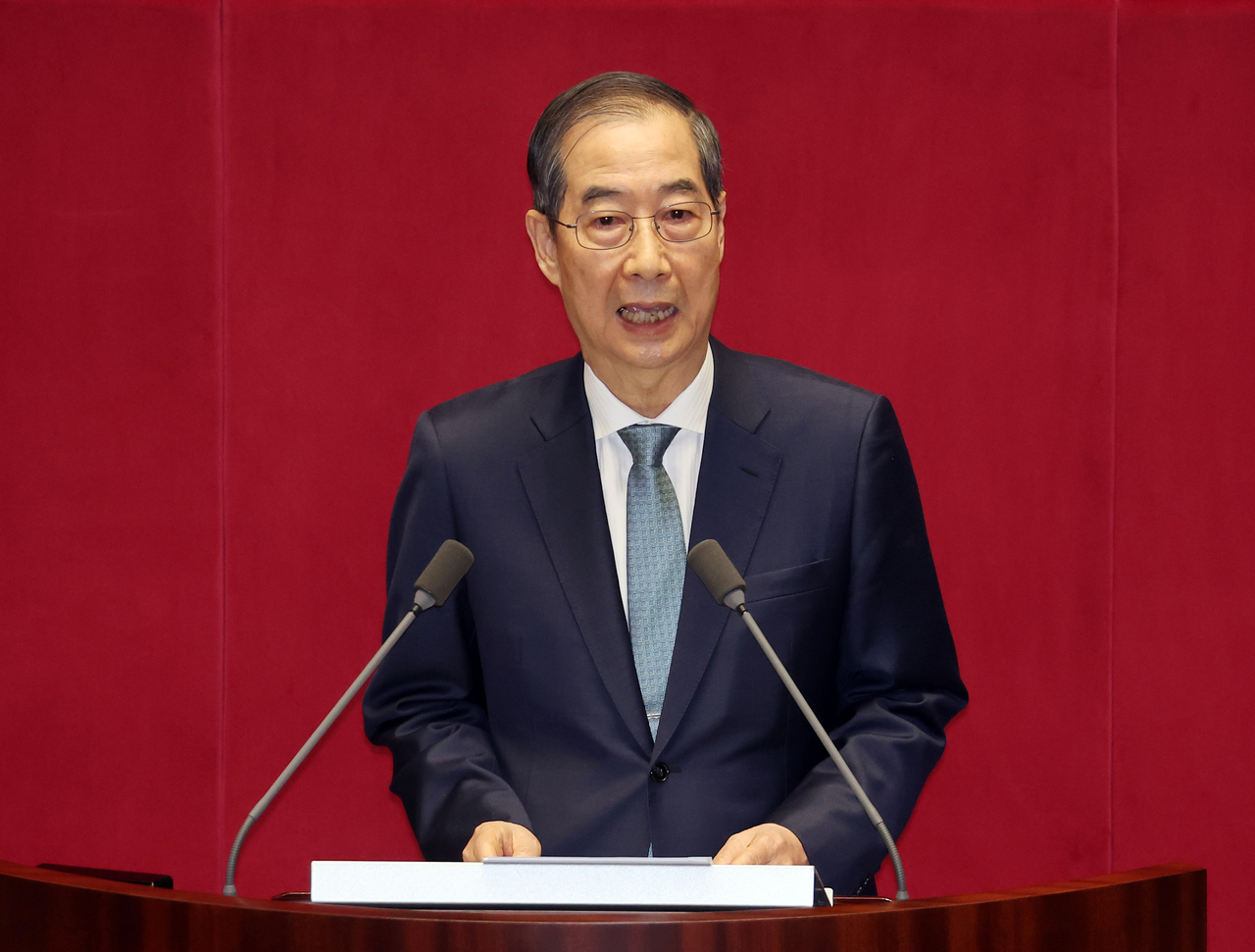
Acting President Han Duck-soo called on the National Assembly on Thursday to swiftly pass the government's extra budget proposal of 12.2 trillion won ($8.55 billion), stressing that time is of the essence to deliver economic relief and support to struggling citizens and industries.
In a budget speech before parliament, the first by an acting leader since 1979, Han laid out the challenges facing the nation, from US tariffs and intensifying global competition in the artificial intelligence and semiconductor industries to high interest rates, unprecedented loan default rates and recovery from last month's worst-ever wildfires.
He described the steps the government has taken to address each challenge, noting in particular the "2+2 trade consultations" between South Korea and the United States slated to take place in Washington later in the day.
"The government will go all-out to find a mutually win-win agreement between the two countries centered on the three key areas of trade balance, shipbuilding and LNG, under the principle that national interest is the top priority," he said.
Still, Han noted there are many tasks that still lie ahead.
"In order to effectively respond to these tasks at the right time, timely investment of additional financial resources is more important than anything," he said.
Han explained that the extra budget proposal calls for allocating 3.2 trillion won to protecting people's lives and property from large-scale natural disasters, such as the deadly wildfires that ravaged the southeastern regions last month.
He said the budget for disaster recovery has been sharply raised from 500 billion won to 1.5 trillion won, with plans to provide 1,000 new rental houses to displaced people and purchase additional AI-powered surveillance cameras and high-performance drones.
Meanwhile, 4.4 trillion won has been allocated to nurturing the AI, semiconductor and other advanced technology industries and supporting businesses faced with liquidity issues due to the threat of US tariffs.
A further 4.3 trillion won will be spent on stabilizing people's livelihoods, including through "burden reduction credits" for small business owners and tailored policy funds for low-income youths.
"I earnestly request your swift deliberation and approval of the supplementary budget proposal submitted by the government," Han said in his speech, adding that in crisis response, timing is just as important as the policy details. "The time that the helping hands of the government's financial resources must reach the desperate is now." (Yonhap)