South Korea's consumer prices grew at the 2 percent level for the fourth consecutive month in April, mainly driven by an increase in food and service costs, government data showed Friday.
Consumer prices, a key gauge of inflation, increased 2.1 percent from a year earlier last month, according to the data from Statistics Korea.
This follows a 2.2 percent on-year rise in January, which marked the steepest on-year increase since July, and 2 percent and 2.1 percent gains in February and March, respectively.
The increase was attributed to a rise in the prices of agro-fisheries products and industrial goods, as well as utility and service costs.
Prices of agro-fisheries products and industrial goods both went up 1.5 percent, while utility costs increased 3.1 percent and service costs climbed 2.4 percent, according to the agency.
Notably, the prices of processed food products sharply rose 4.1 percent as a weak Korean won drove up import costs of ingredients.
The cost of dining out also escalated 3.2 percent, marking the biggest on-year increase in 13 months, due to the weak local currency.
The Korean won has been under pressure due to political uncertainty following former President Yoon Suk Yeol's short-lived imposition of martial law on Dec. 3. The situation was further exacerbated by US President Donald Trump's tariff escalation.
On the other hand, the prices of petroleum products dropped 1.7 percent amid a recent decline in global oil prices.
Core inflation, which excludes volatile food and energy prices, grew 2.1 percent on-year, surpassing the 2 percent mark for the first time in seven months.
Excluding the volatile agro-fisheries and petroleum product prices, the core inflation added 2.4 percent on-year in April, compared with the 2.1 percent increase the previous month.
"Core inflation was greater than the overall consumer price increase as it does not reflect the decrease in vegetables, fruits and petroleum products, but we cautiously predict the current price trend will be maintained for the foreseeable future," said Lee Doo-won, an official at Statistics Korea.
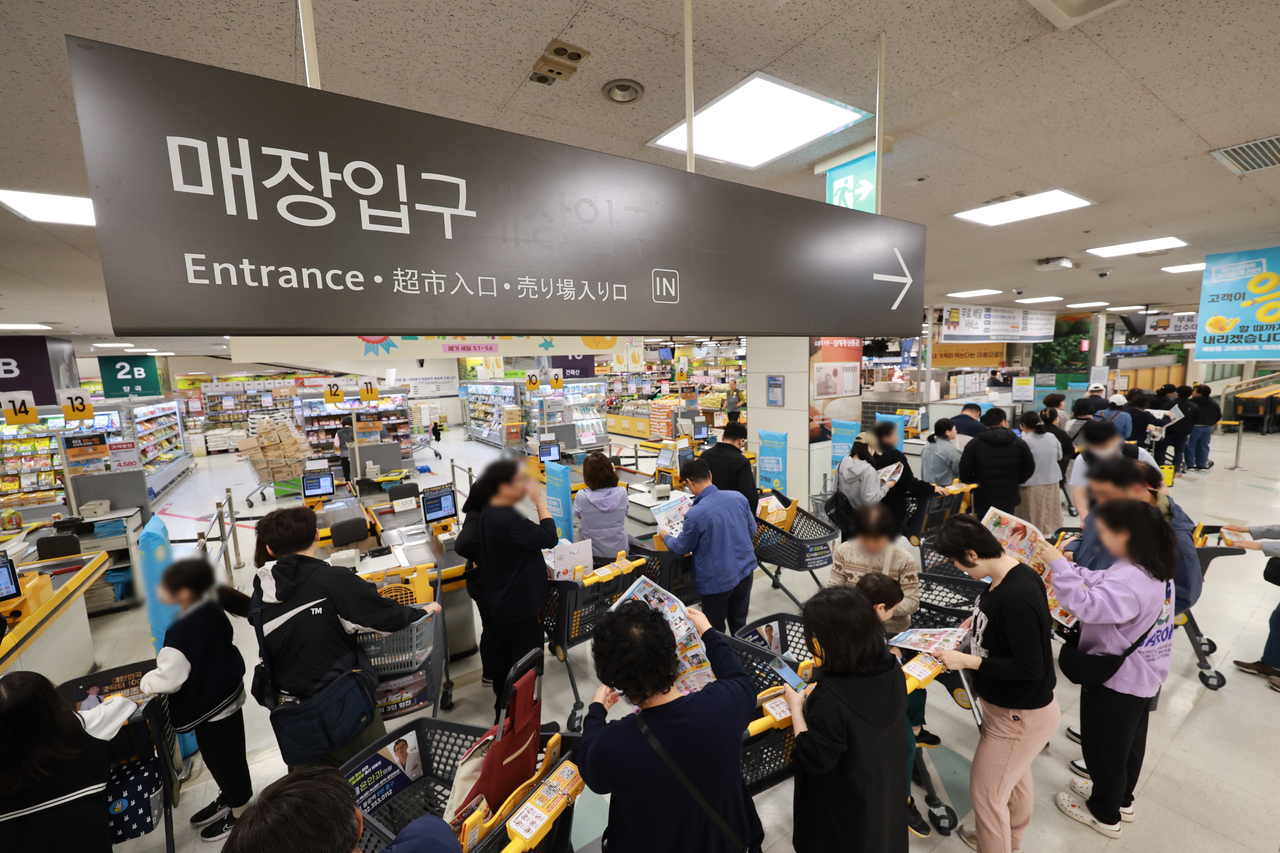
Prices of daily necessities -- 144 items closely related to people's everyday lives, such as food, clothing and housing -- went up 2.4 percent in April, the same growth as the previous month. (Yonhap)