After the resignation of Finance Minister and Deputy Prime Minister Choi Sang-mok late Thursday, the number of incumbent Cabinet members dropped to 14, raising concerns of the Cabinet being paralyzed.
Earlier in the day on Thursday, acting President and Prime Minister Han Duck-soo had already announced his resignation to launch his own presidential bid. His immediate successor, Choi, stepped down hours later as he faced possible impeachment by the National Assembly, ultimately handing the burden of the presidency to the third in line to be acting president: Education Minister Lee Ju-ho.
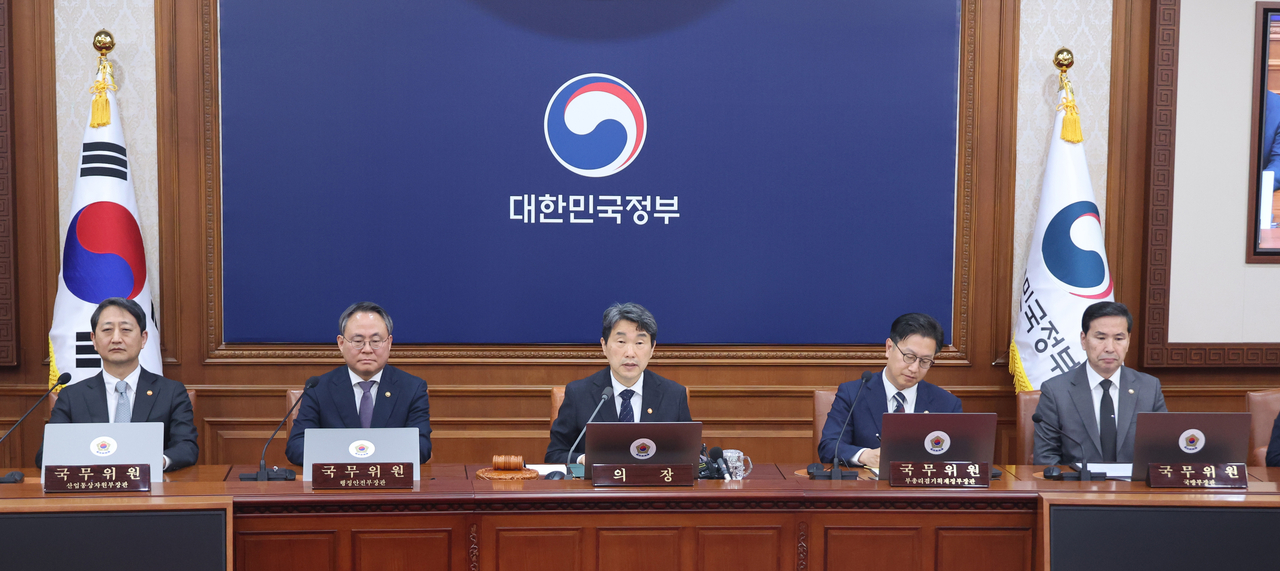
According to Article 88 of the Constitution, the Cabinet in South Korea is to consist of the president and the prime minister, along with between 15 and 30 Cabinet members. This has sparked controversy over whether a Cabinet meeting could be held at all, as the constitutional requirement of "at least 15 members" for its composition may not have been met.
There are currently 19 ministries, with each minister serving as a Cabinet member. If the president and the prime minister are added, the number of the Cabinet members becomes 21.
However, out of the 21, seven of the positions remain vacant.
Former President Yoon Suk Yeol did not appoint a successor after Kim Hyun-sook, who headed the Ministry of Gender Equality and Family, resigned in February 2024. Following the martial law debacle in December last year, former Defense Minister Kim Yong-hyun and former Interior Minister Lee Sang-min resigned. On April 8, former Labor Minister Kim Moon-soo stepped down to launch his bid for the People Power Party's presidential nomination.
With Yoon having his impeachment upheld by a Constitutional Court ruling that formally removed him from office, then Han Duck-soo and Choi Sang-mok resigning, vacancies in the Cabinet have now added up to seven.
That leaves Lee Ju-ho, already a member of the Cabinet as education minister, to fulfill the roles of acting president and prime minister, which are dictated in Article 88 to also be chairperson and vice chairperson, respectively.
The Ministry of the Interior and Safety sought to provide clarification on Friday regarding controversy over the quorum for a Cabinet meeting, stating, "A Cabinet meeting can be convened if at least 11 members are present."
The ministry further stated, "The Cabinet meeting regulations specify that the quorum for a meeting is based on 'members' rather than 'current members,' so the quorum is the majority of the 21 members, which is 11."
Decisions are made with the approval of two-thirds of those in attendance, it added.
This is not the first time that the number of Cabinet members — aside from the president and prime minister — has fallen under the threshold of 15. During the Lee Myung-bak administration, which had just 15 ministries at the time, a vacancy occurred in the interior minister position in 2009. Though the number of sitting ministers dropped to 14 at the time, the Cabinet maintained its validity.
lee.jungjoo@heraldcorp.com